We live in a beige world. Look down at your feet right now. Chances are, you are staring at grey laminate, brown hardwood, or neutral tile. We have been conditioned to believe that floors should be invisible, the quiet background characters of our homes. We save the color for the throw pillows and the art on the walls.
But what if the art was the floor? And what if that art looked good enough to eat?
Imagine walking into your kitchen on a gloomy Tuesday morning. Outside, it is raining and grey. But inside, beneath your feet, is an explosion of golden yellow, zesty orange, and lime green. You are walking on a sun-drenched mosaic of citrus slices, suspended forever in crystal-clear glass.
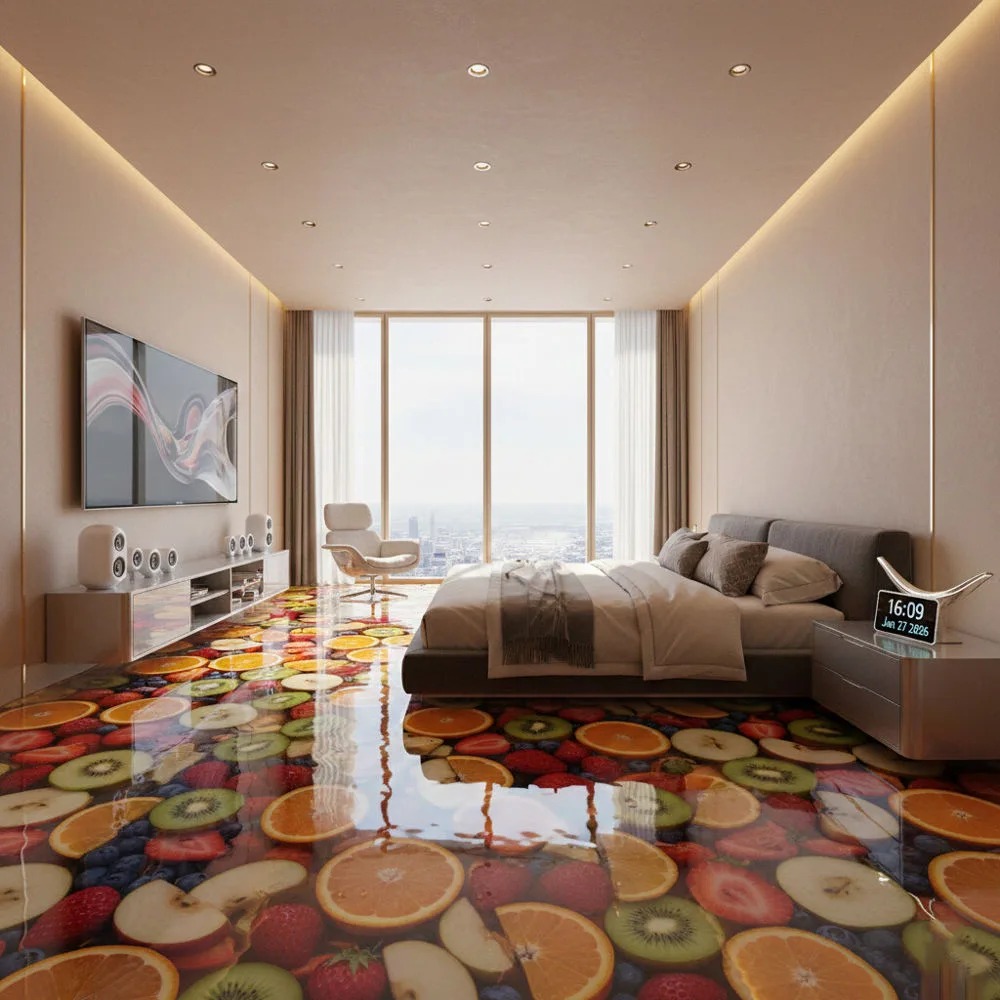
This is the delicious reality of the Epoxy Fruit Floor.
It is one of the most audacious, joyful, and stunning trends to hit the interior design world in decades. It is where the rustic charm of “Cottagecore” crashes into the slick durability of modern industrial materials. It is not just flooring; it is a time capsule. It preserves the peak of summer freshness and locks it into your home permanently.
In this feature, we are peeling back the layers of this juicy design movement. We will explore the craftsmanship behind the pour, the incredible visual effects of botanical resin, and how turning your floor into a fruit basket can change the entire energy of your home.
The Rebellion Against the Boring
To understand the Epoxy Fruit Floor, you have to understand the “Dopamine Decor” movement. After years of minimalism—white walls, white floors, white furniture—people are starving for color. We want homes that make us smile the second we walk through the door.
A hardwood floor is “tasteful.” A floor made of real dried strawberries and kiwis is “joyful.”
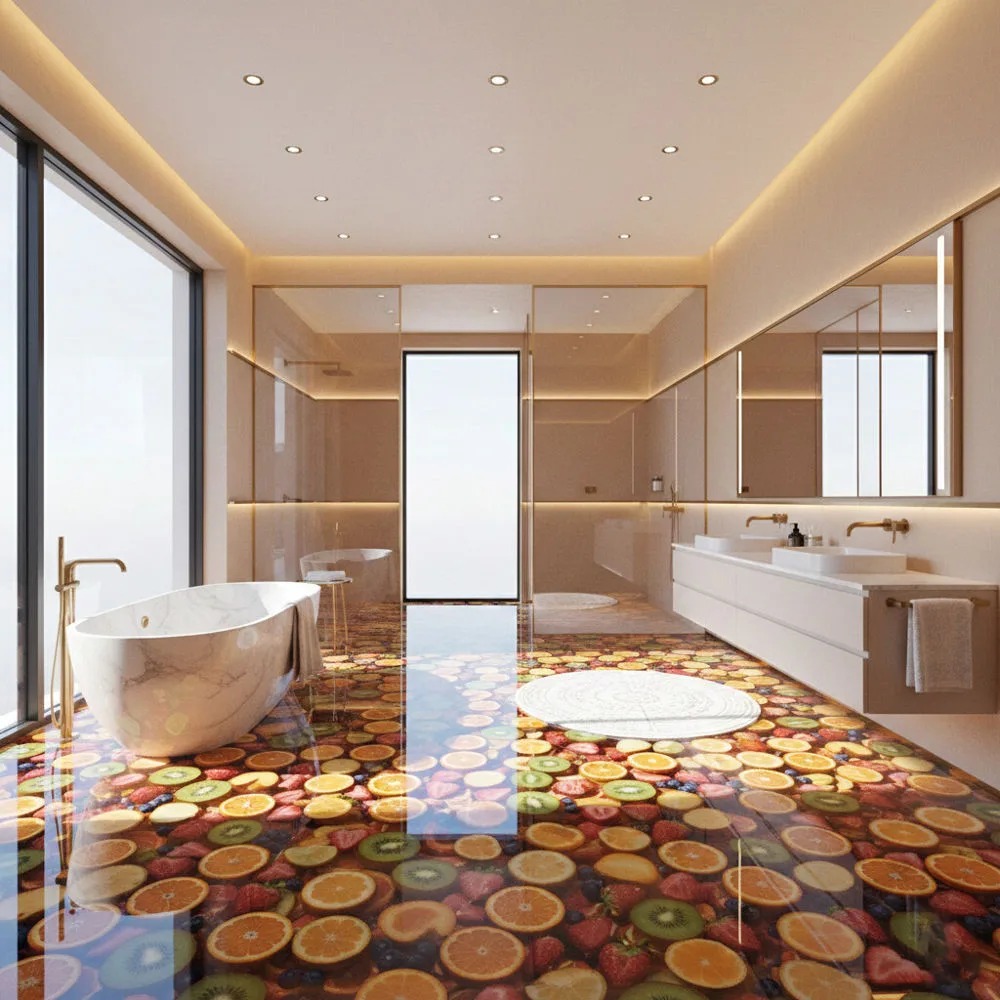
This trend takes the concept of the terrazzo floor—where chips of stone or glass are embedded in concrete—and swaps the stone for organic matter. It turns the floor into a massive biological slide. When you look down, you see the intricate veins of a lemon slice, the seeds of a kiwi, or the star pattern of an apple core. It connects the indoors to the earth in a way that wood planks never could. It is vibrant, loud, and unapologetically fun.



The Chemistry of Preservation: The “Mummified” Mosaic
You might be asking: “Wait, won’t the fruit rot?”
This is the most common misconception about the Epoxy Fruit Floor. You cannot simply slice a fresh orange and pour resin over it. If you did, the moisture inside the fruit would react with the epoxy, turning it cloudy, and eventually, the fruit would decompose into a brown mush inside your floor.
The secret lies in the preparation. This is not just construction; it is preservation science.
Every single slice of fruit destined for the floor must be completely dehydrated. The fruit is sliced thin—usually 3 to 5 millimeters—and slow-dried until it is essentially a fruit chip. It must be bone dry. This process removes the water but keeps the cellular structure and, most importantly, the color.
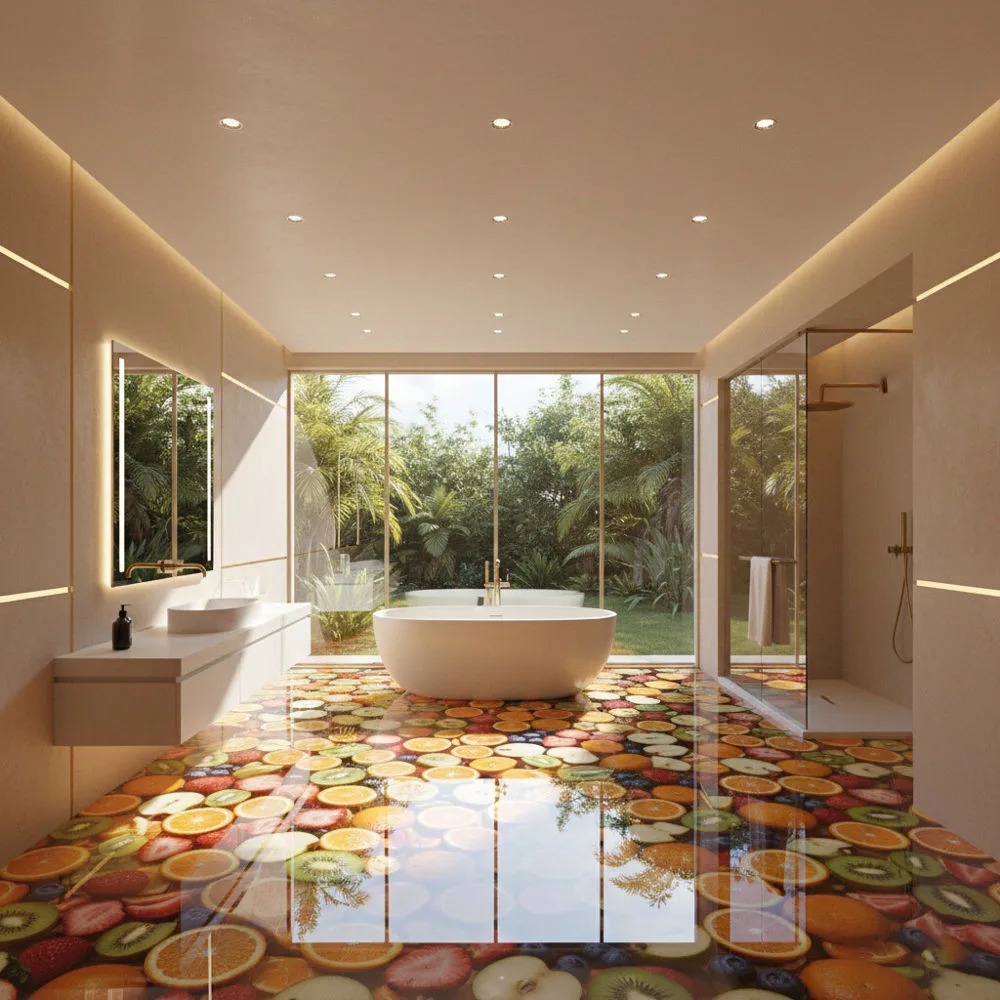
Once the fruit is “mummified,” it is arranged on the subfloor. This is the artistic phase. Installers (or brave DIYers) spend hours arranging thousands of lemon wheels or strawberry slices into mandalas, gradients, or random organic scatters.
Then comes the “The Great Pour.” A clear, UV-resistant epoxy resin is poured over the arrangement. It saturates the dried fruit, filling every air pocket. As it cures, it hardens into a surface that is stronger than concrete. The fruit is sealed in an air-tight, bacteria-free tomb. It will look as fresh in ten years as it did the day it was poured.
The Stained Glass Effect: Playing with Light
The true magic of an Epoxy Fruit Floor reveals itself when the sun comes out.
Unlike tile or wood, which are opaque, dried fruit and clear resin are translucent. Citrus fruits—lemons, limes, oranges, grapefruits—are the superstars of this genre because of their cellular structure.
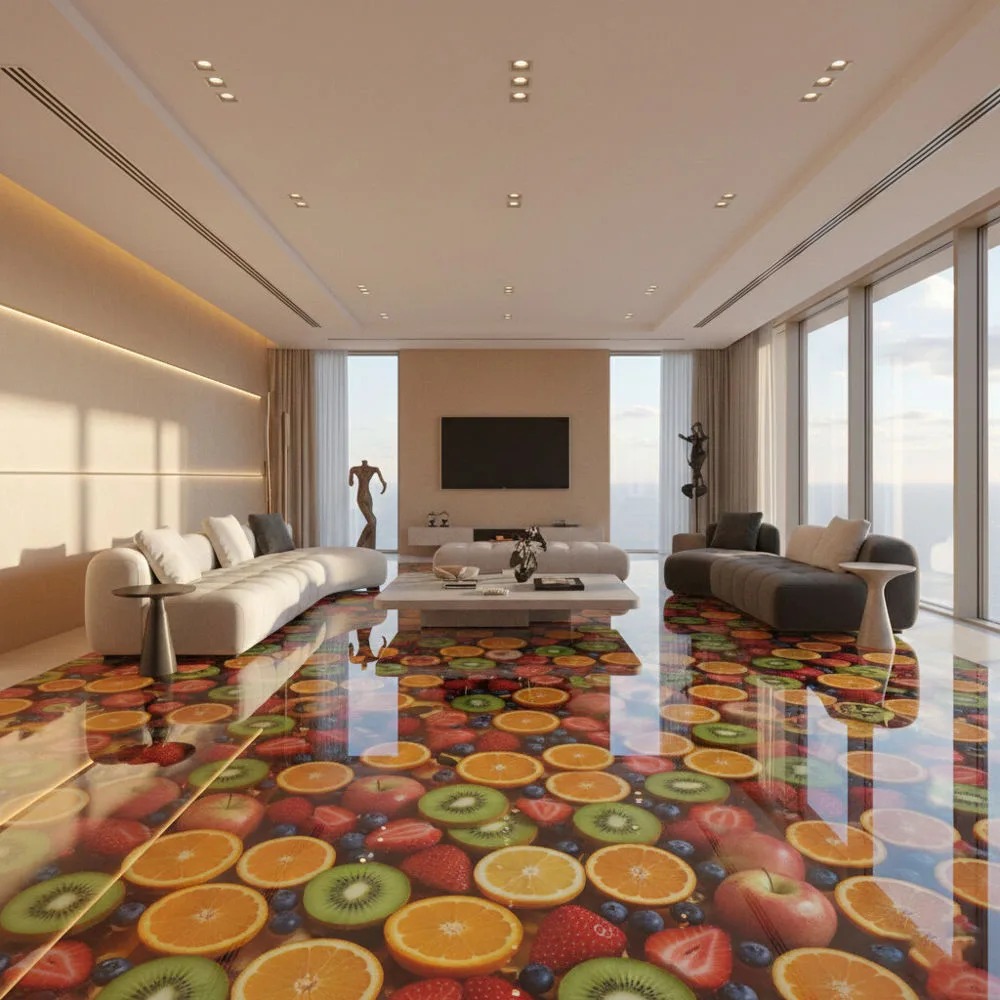
When sunlight hits a floor embedded with orange slices, the light doesn’t just bounce off; it penetrates the fruit. The floor seems to glow from within. It creates a “stained glass” effect beneath your feet. The amber and gold tones of the citrus warm up the reflected light, casting a cozy, honey-colored glow across the entire room.
This is why these floors are exceptionally popular in sunrooms, pantries, and breakfast nooks. They harvest the sunlight. In the morning, walking on the floor feels like walking on a sheet of illuminated marmalade. It is a sensory experience that changes throughout the day as the sun moves across the sky.
The Flavor Palette: Designing Your Mix
Just as you would choose a paint color, you must choose your “flavor” when designing an Epoxy Fruit Floor. The type of fruit you select dictates the mood of the room.
The Citrus Burst (The Energy Booster)
This is the most popular style. A mix of lemons (yellow), limes (green), and oranges (orange).
- The Vibe: High energy, clean, and fresh. It screams “morning person.”
- Best For: Kitchens and bathrooms. It creates a psychological association with cleanliness and zest.
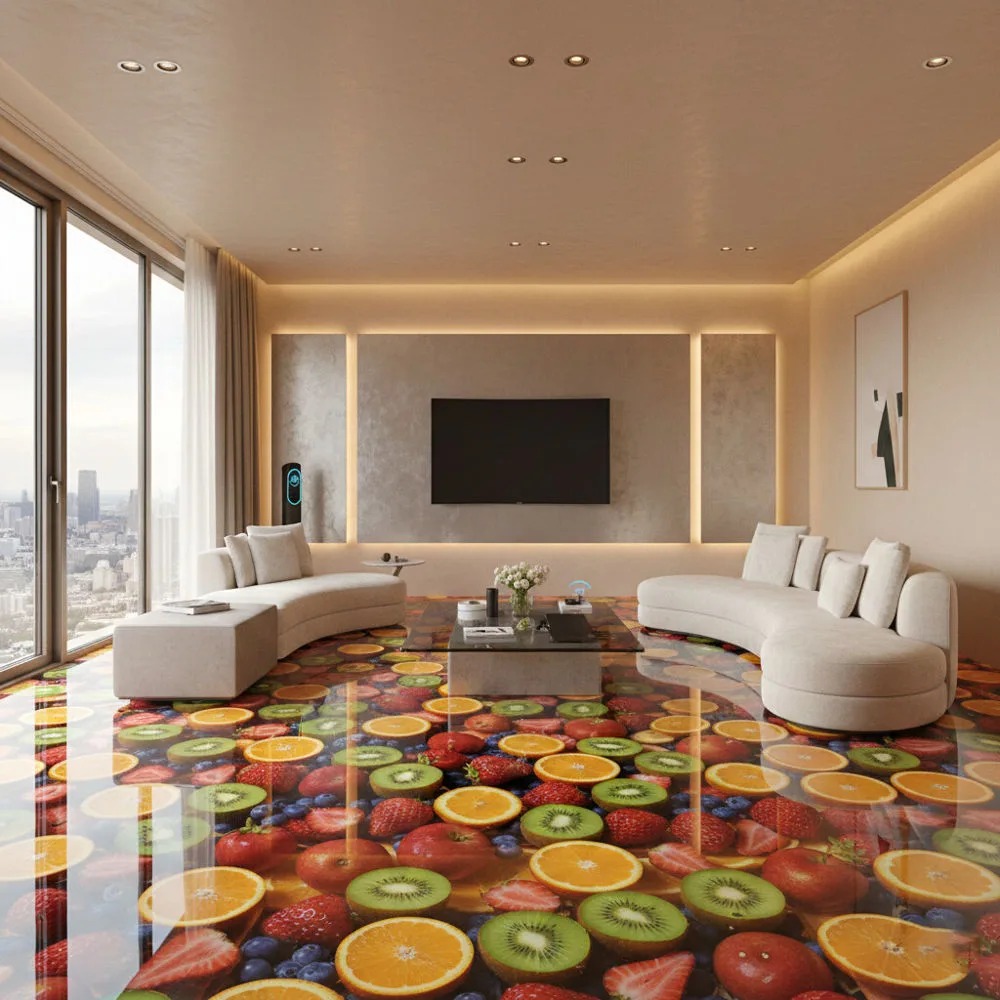
The Berry Patch (The Romantic)
Using slices of strawberries, dried cranberries, or even pomegranate seeds.
- The Vibe: Richer, moodier, and warmer. The deep reds and pinks create a more romantic, “English Cottage” aesthetic.
- Best For: Pantries, wine cellars, or a small powder room.
The Orchard Mix (The Maximalist)
This is pure chaos in the best way. Apples, pears, kiwis, starfruit, and citrus all mixed together.
- The Vibe: Abundance. It looks like a cornucopia spilled across the floor. The starfruit, in particular, adds a beautiful geometric star shape that breaks up the roundness of the other fruits.
- Best For: Mudrooms or entryways where you want to make a massive first impression.
The Texture of Time
One of the most fascinating aspects of an Epoxy Fruit Floor is the visual depth. Because the resin is poured in layers (usually a seal coat, a flood coat, and a top coat), the floor has a 3D quality.
The fruit isn’t just painted on the surface; it is suspended inside the surface. When you kneel down and look closely, you can see the fruit floating millimeters above the subfloor.
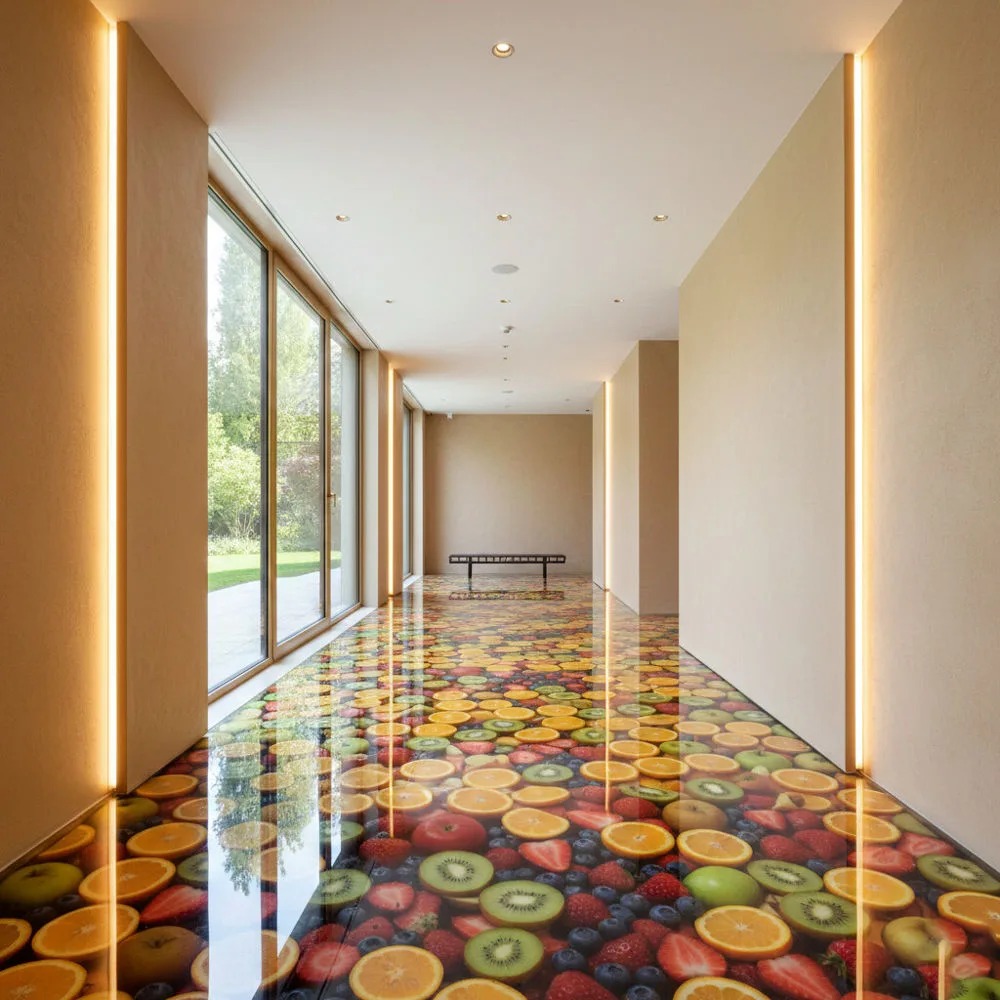
However, the surface itself is perfectly smooth. High-quality floor epoxy self-levels, creating a sheet of glass. Walking on it barefoot is a unique sensation. Your eyes tell you the floor is textured—you see the rough rind of the lemon and the seeds of the strawberry—but your feet feel only cool, seamless smoothness. It is a delightful cognitive dissonance.
Durability: Is It Just for Show?
Many people assume a floor made of fruit is fragile. In reality, it is a tank.
Epoxy resin is industrial-grade material. It is used in garage floors, warehouses, and factories. Once cured, an Epoxy Fruit Floor is:
- Waterproof: Perfect for spills in the kitchen.
- Shock Resistant: You can drop a cast-iron pan on it, and while you might dent the resin (which can be buffed out), you won’t hurt the fruit protected underneath.
- Pet Proof: Claws cannot scratch deep enough to reach the embedded art.
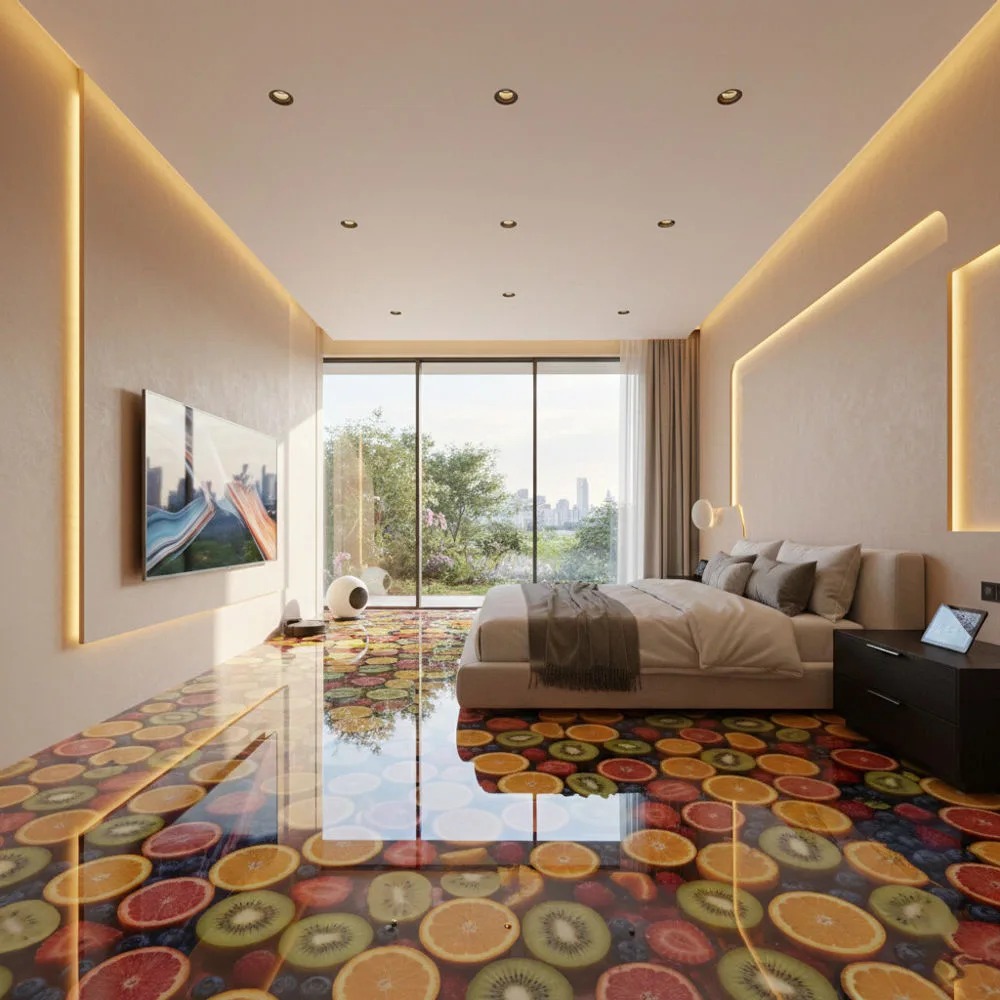
However, like all high-gloss surfaces, it does scuff. Over time, the “mirror finish” will develop a patina of fine scratches from foot traffic. For many, this adds to the charm, softening the gloss. For perfectionists, a simple buffing and polishing every few years brings the “wet look” right back.
The Conversation Piece to End All Conversation Pieces
We design our homes to reflect who we are. Some of us are serious. Some of us are minimalists. And some of us are vibrant, messy, and full of life.
Installing an Epoxy Fruit Floor is a declaration. It says that you don’t take life too seriously. It says that you value creativity over convention.
Imagine hosting a dinner party. Your guests walk into the kitchen to grab a drink. They look down. The conversation stops. Suddenly, everyone is on their knees, pointing out their favorite slices, asking how it was done, touching the surface. The floor becomes the entertainment. It is no longer just a surface to walk on; it is a gallery installation that you happen to live inside.
Conclusion: The Sweetest Foundation
Summer is fleeting. The flowers fade, the leaves turn brown, and the grey skies return. We spend so much energy trying to keep the feeling of warmth and abundance alive in our homes.
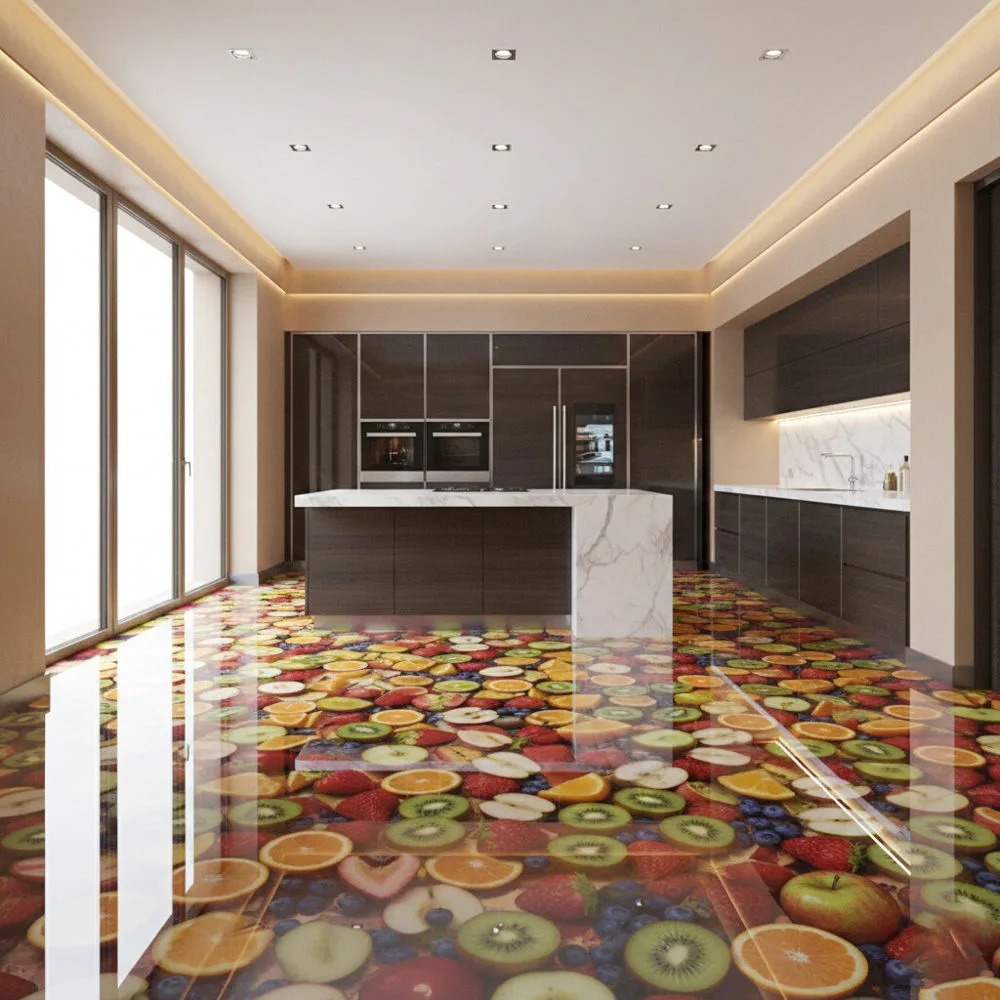
The Epoxy Fruit Floor achieves the impossible: it makes summer permanent.
It captures the essence of a harvest—the color, the intricate patterns of nature, the golden light—and freezes it in time. It turns the mundane act of walking to the fridge into a walk through a sunlit orchard.
So, if you are tired of the beige, the grey, and the safe choices, look to the fruit bowl. Slice it up, dry it out, and pour the resin. Build a foundation for your home that is as sweet, colorful, and unique as life itself. Step onto the fruit, and let the sunshine in from the ground up.