The modern world is loud. It is bright, fast, and relentlessly tethered to the ground. We spend our days navigating traffic, scrolling through endless feeds, and staring at concrete horizons. When the day ends, we retreat to bedrooms that are often just functional boxes—four walls, a mattress, and a window that looks out onto the very world we are trying to escape.
But sleep should be a departure. It should be a journey to somewhere else entirely.
Imagine, for a moment, that you do not walk into your bedroom; you board it. You step through a circular pressure door. The air feels different here—calmer, quieter. You are surrounded by the soft hum of machinery and the gentle, hypnotic glow of blue light. Outside your window, the chaotic city has vanished, replaced by the silent, slow-motion ballet of marine life.
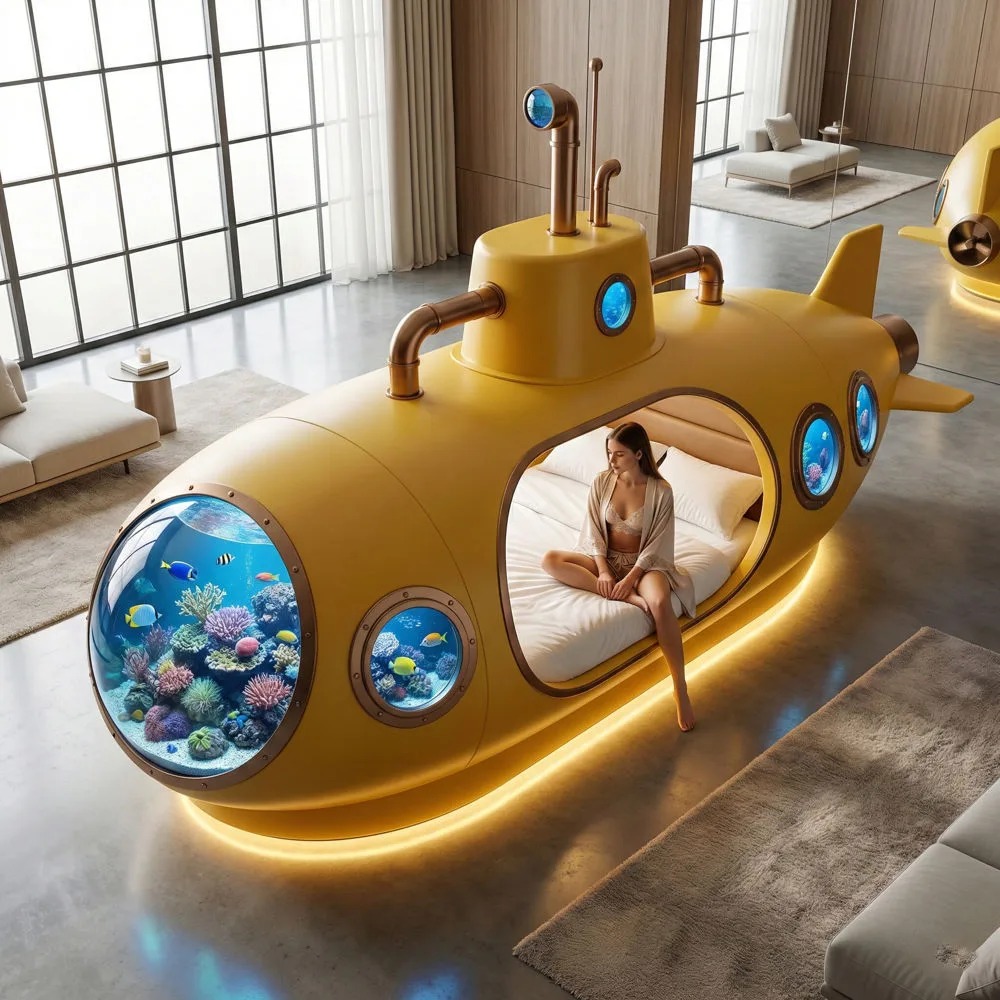
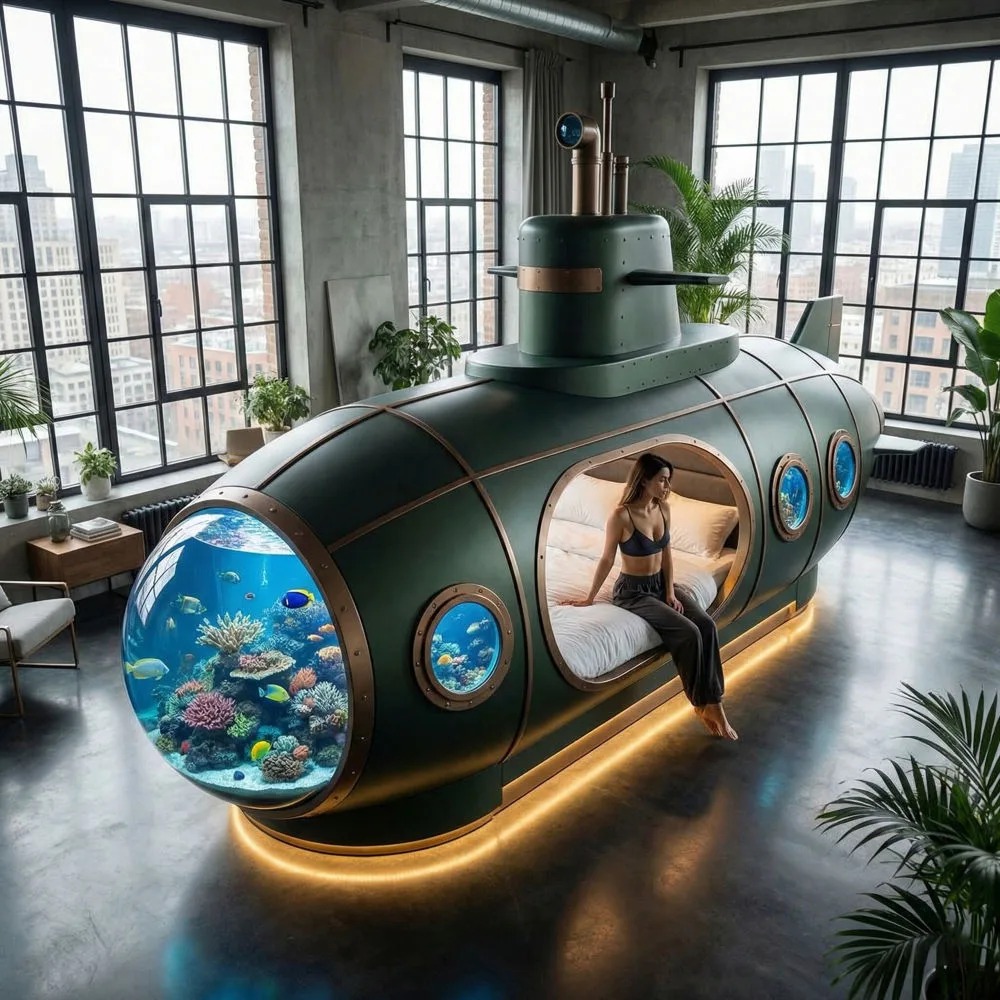
This is not a scene from a science fiction novel. This is the rising phenomenon of the Submarine Aquarium Bed.
It is the boldest statement in interior design today. It rejects the beige, the minimal, and the ordinary in favor of deep-sea immersion. It is furniture that tells a story, turning the act of sleeping into an nightly expedition to the bottom of the ocean.
The Psychology of the Deep: The “Denning” Instinct
To understand the magnetic appeal of the Submarine Aquarium Bed, we have to look past the aesthetics and into the human psyche. Why do we love treehouses, forts, and window seats? It is the “denning instinct.”
Humans are biologically wired to feel safe in enclosed, protected spaces that offer a view of the outside. A submarine bed is the ultimate manifestation of this instinct. It is a fortress. The design usually features a curved, enclosed frame that wraps around the sleeper, mimicking the hull of a vessel.
When you lie inside, you feel held. The “hull” separates you from the worries of the surface world. It creates a psychological barrier. Inside the vessel, you are the captain. You are safe. The crushing pressure of daily life cannot breach the walls. This deep sense of security promotes a quality of rest that an open, exposed platform bed simply cannot match.
The Aesthetic Divide: Choosing Your Vessel




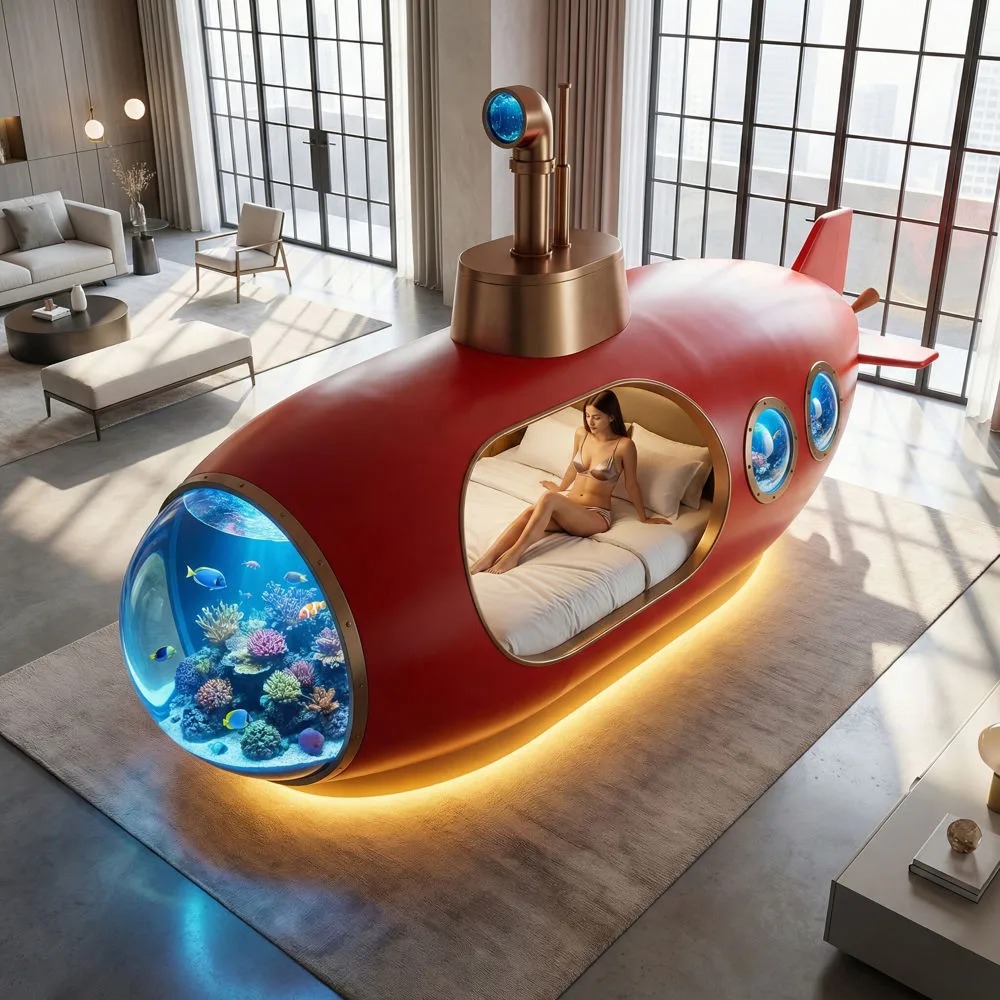
The world of Submarine Aquarium Beds is not a monolith. It is a spectrum of design that caters to two very different fantasies. When commissioning or building your vessel, you are essentially choosing your timeline: the romantic past or the sleek future.
The Nautilus Class (Victorian Industrial)
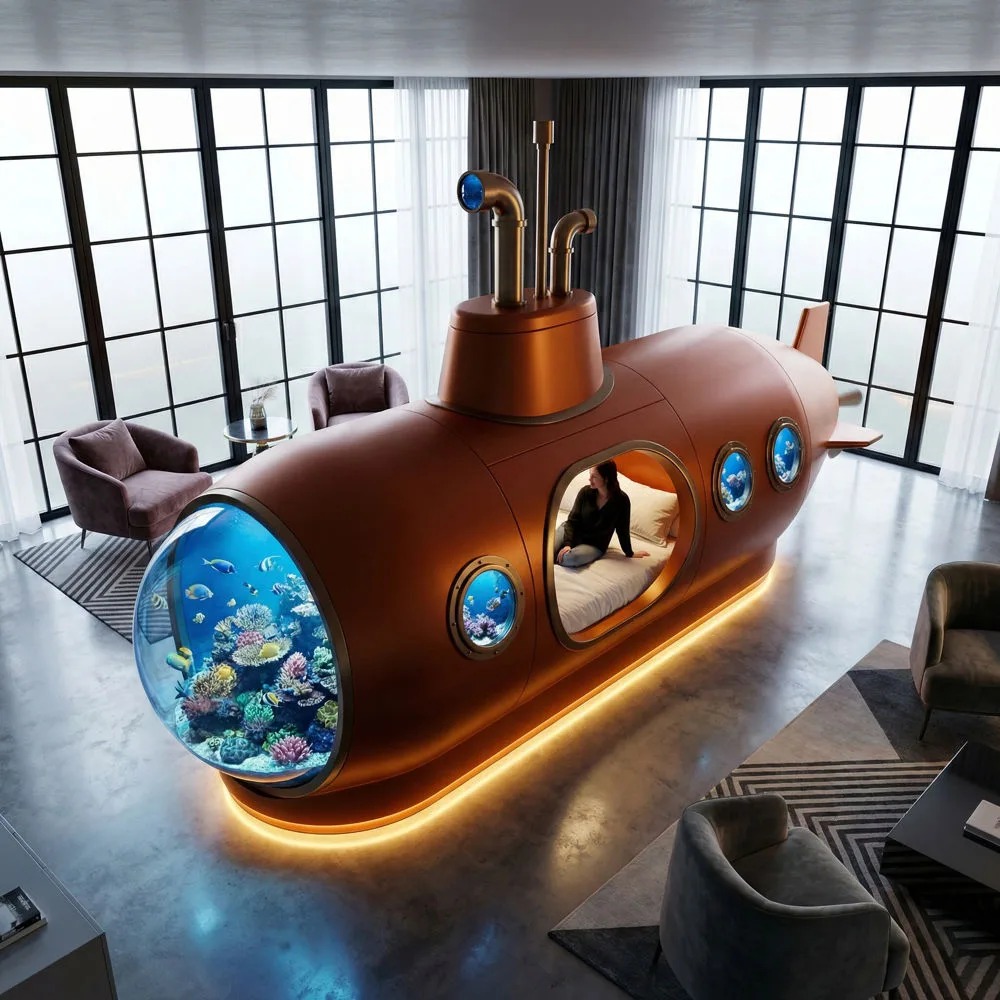
This style pays homage to Jules Verne and the steampunk genre. It is for the dreamer who wants their room to feel like a library at the bottom of the sea.
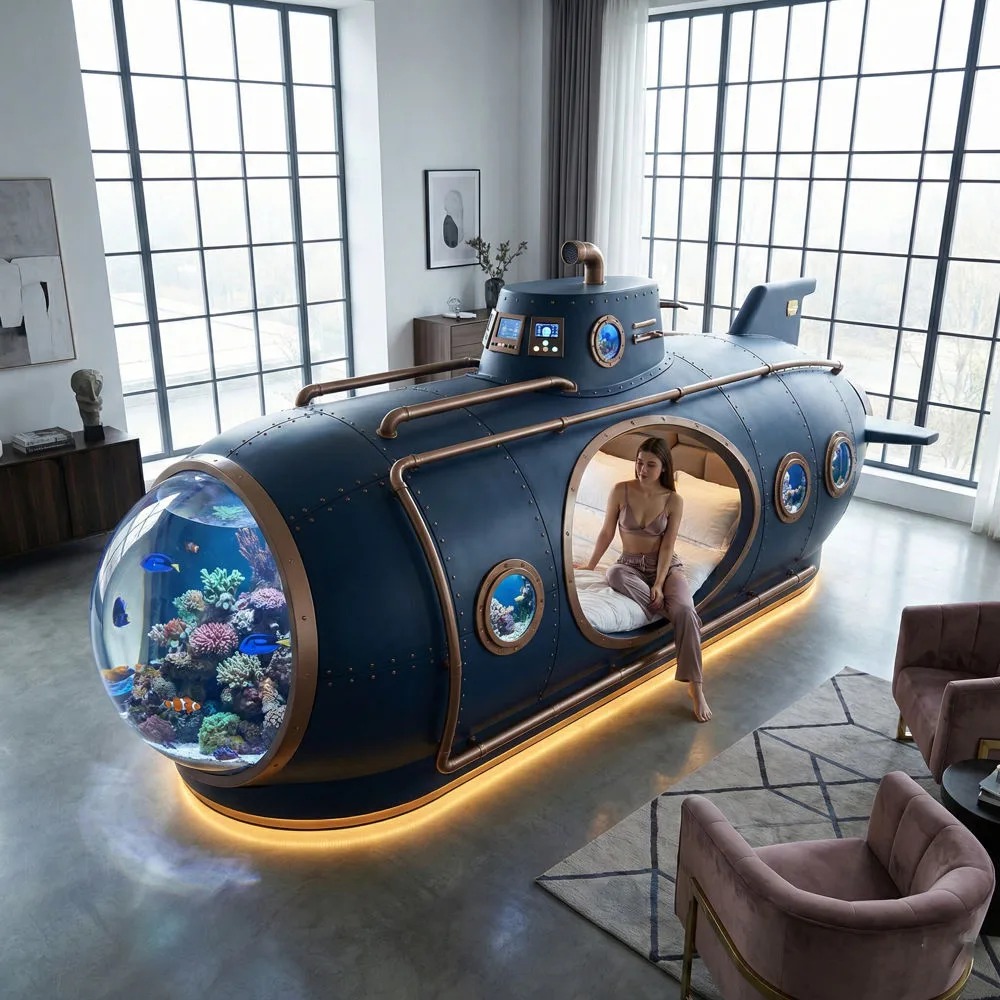
- Materials: This design language speaks in brass, copper, and dark mahogany. The “hull” is often riveted, showing the mechanical strength of the structure.
- The Atmosphere: Think of warm amber lighting, leather-tufted headboards, and analog gauges that needles twitching to measure fictional “depth” and “oxygen levels.”
- The Experience: It feels rich and historic. It is a gentleman’s study submerged. It invites you to read a leather-bound book while the fish swim past your porthole.
The Triton Class (Futuristic Research)
On the other end of the spectrum is the sci-fi aesthetic, inspired by modern deep-sea submersibles and space travel.
- Materials: High-gloss fiberglass, matte white finishes, and brushed aluminum. The lines are clean, curved, and aerodynamic.
- The Atmosphere: The lighting is key here—cool blues, UV purples, and hidden LED strips that make the bed frame appear to float. Control panels are digital, often integrating smart home features so you can adjust the room’s temperature or lighting from a touch screen built into the wall of the bed.
- The Experience: It feels clinical in a soothing way. It is a sensory deprivation tank. It creates a space so clean and futuristic that it cleanses the mind of clutter.
The Living View: Aquascaping the Viewport
The defining feature of a Submarine Aquarium Bed is, of course, the window. Without the view, it is just a bunk bed. The integration of the aquarium is where the magic truly happens.
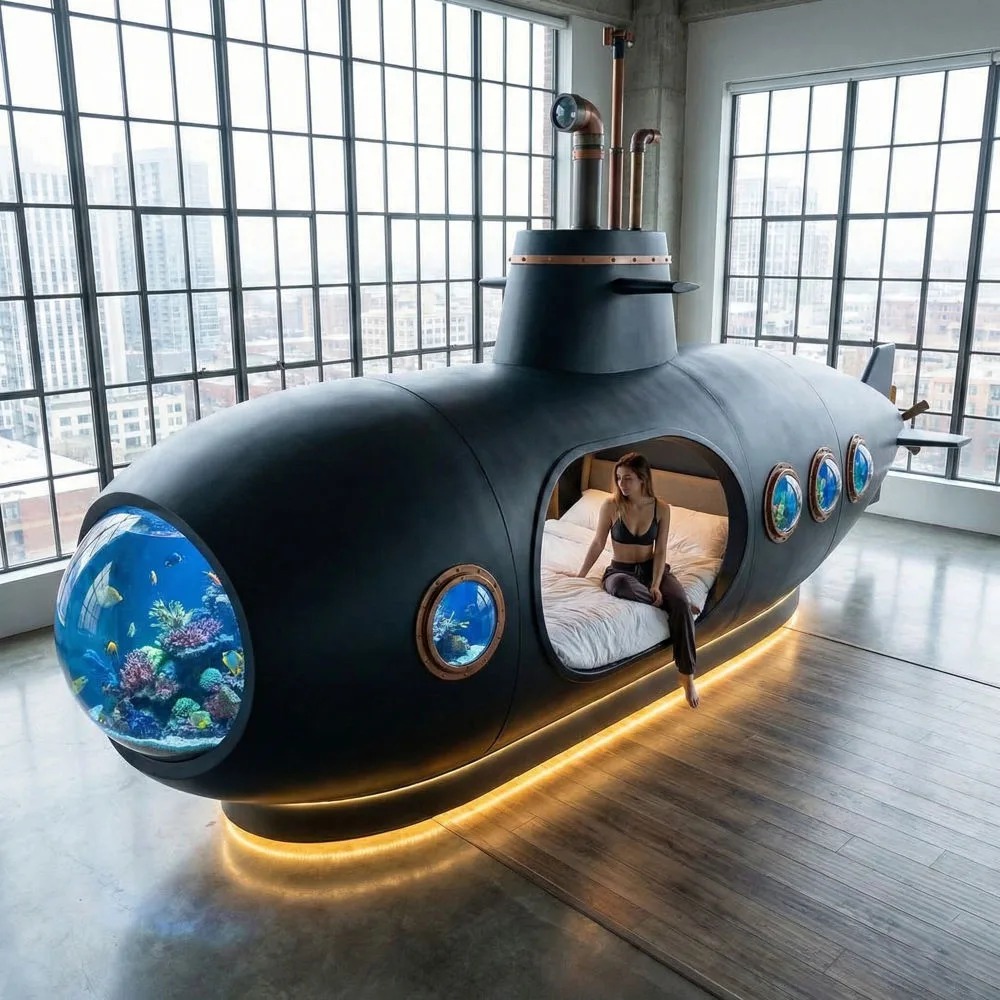
In the most luxurious installations, the headboard is replaced by a massive, custom-built acrylic tank. This is not just a fish bowl; it is a slice of the ocean ecosystem.
The Caustic Light Show
The most underrated aspect of sleeping next to an aquarium is the light. When water moves, it creates “caustics”—those dancing ribbons of light that ripple across the floor of a swimming pool. In a submarine bedroom, the tank lights project these ripples onto your duvet and the ceiling of the room. It is a natural, hypnotic light show that mimics being underwater. It triggers a primal relaxation response, slowing the heart rate and inducing sleep.
The Crew of the Ship
The choice of marine life completes the narrative.
- The Silent Gliders: Keeping slow-moving fish like Discus or Angelfish adds to the tranquility. They drift rather than dart, enhancing the slow-motion feel of the room.
- The Night Watch: Incorporating nocturnal species means that when the room lights go out and the tank switches to “moonlight” mode, a whole new world awakens. Catfish and eels begin to patrol the sand, giving the captain something to watch during bouts of insomnia.
The Digital Descent: The Dry Submarine
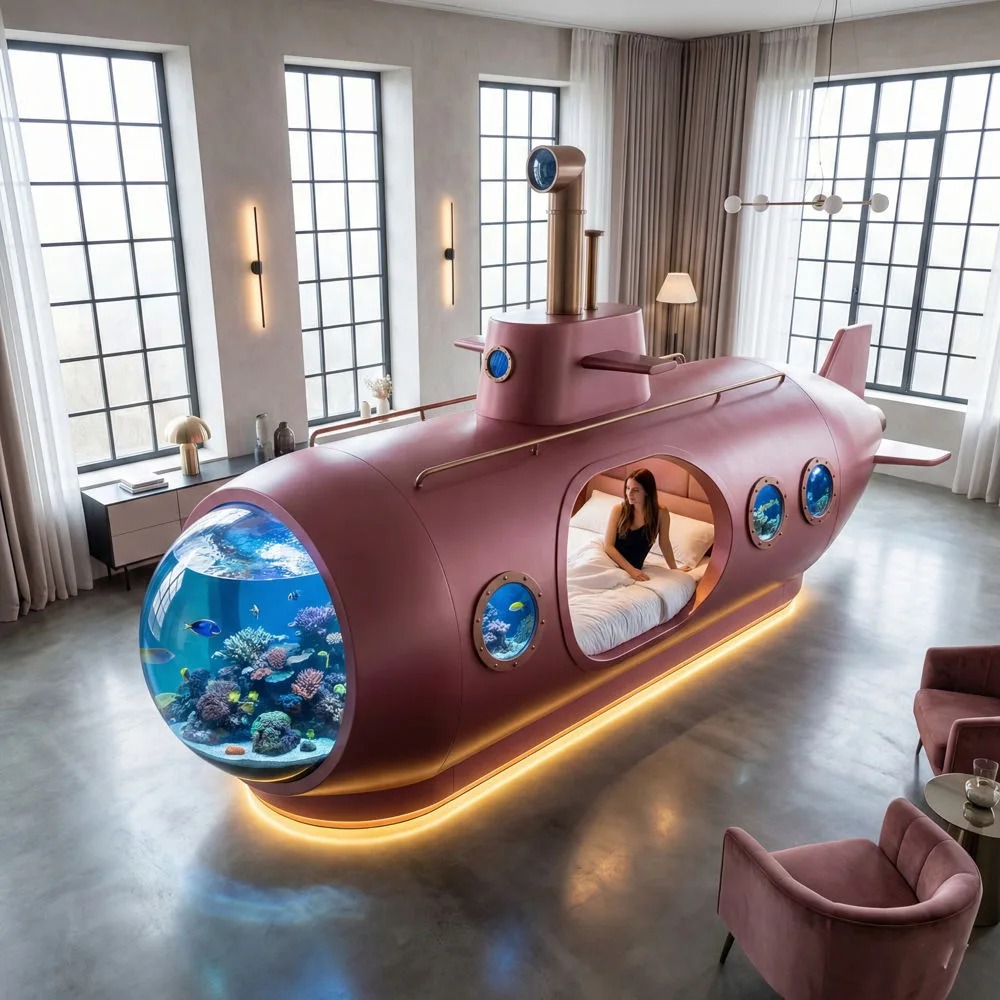
Let’s address the elephant (or the whale) in the room: Real aquariums are heavy, expensive, and require maintenance. Not every floor joist can support 2,000 pounds of saltwater.
This has given rise to the Digital Submarine Aquarium Bed.
Instead of glass and water, the “portholes” are high-definition 4K OLED screens embedded into the hull of the bed.
- Infinite Oceans: With a digital setup, you are not limited to the fish you own. One night, you can sleep next to a coral reef in Fiji. The next, you can drift through a bloom of bioluminescent jellyfish. You can even simulate a descent into the Marianas Trench, watching the water turn from blue to black.
- The Soundscape: These beds often integrate surround sound into the headboard. It isn’t just about seeing the ocean; it is about hearing the low, resonant thrum of the engine, the sonar pings, and the muffled bubbling of water pressure. It is a full-body immersion that tricks the brain into believing you are submerged.
The Ultimate Childhood Territory
While adults appreciate the aesthetics, for a child, a Submarine Aquarium Bed is the holy grail of room design. It transforms a bedroom from a place of punishment (time-outs and bedtimes) into a place of adventure.
Designers of children’s submarine beds lean heavily into playability.
- The Periscope: A functional periscope using mirrors allows the child to lie in the top bunk and spy on the hallway or the backyard.
- Hidden Compartments: “Smuggler’s hatches” built into the floor or walls of the bed provide secret storage for toys and treasures.
- The Control Center: Dummy switches, knobs, and levers allow the child to “pilot” the room.
For a child, this structure provides a critical sense of ownership. It is their territory. It fosters imagination and creative play in a way that a standard twin bed never could. It is the vessel that will carry them through the dreams of their childhood.
Designing the Dock: The Room Around the Bed
A Submarine Aquarium Bed is a commanding piece of furniture. You cannot simply drop it into a room with floral wallpaper and hope it works. The entire room must become the “dock” or the “ocean.”
The Murals: To sell the illusion, the walls of the room are often painted in a gradient—light blue near the ceiling fading to deep navy near the floor. Hand-painted murals of kelp forests, distant whales, or sunken ruins extend the horizon.
The “Industrial” Flooring: Plush white carpet ruins the vibe of a submarine. Designers often opt for grey wood planks (resembling weathered decking) or metallic epoxy floors that look like the interior of a ship.
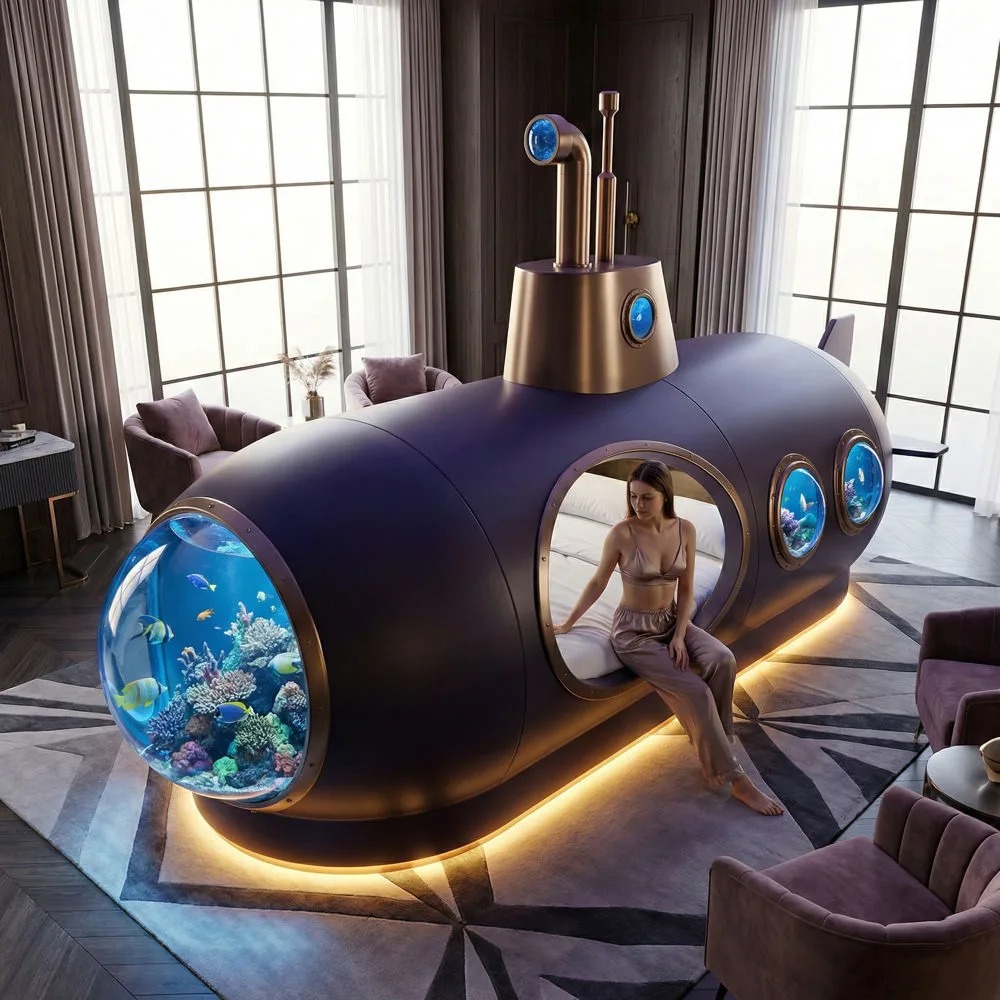
The Lighting Plan: There should be no “big light.” The atmosphere relies on accent lighting. Sconces that look like bulkhead lights, LED strips under the bed, and projection lamps that cast water ripples on the ceiling are essential.
Conclusion: The Final Frontier of Rest
We spend one-third of our lives asleep. Yet, we treat the environment where we sleep as an afterthought. We prioritize the living room where guests see us, or the kitchen where we cook, but the bedroom is often neglected.
The Submarine Aquarium Bed challenges that priority. It argues that the place where we dream deserves to be the most magical place in the home.
It is an investment in wonder. It is a rejection of the mundane. When you seal the hatch and drift off to the sound of bubbling water and the glow of the deep, you are not just getting eight hours of rest. You are embarking on a voyage. You are leaving the surface world behind, with all its noise and gravity, and floating freely in the suspended animation of the deep.
In a life that is often too serious, the submarine bed offers a nightly permission slip to play, to imagine, and to rest in the embrace of the abyss. It is, quite simply, the coolest way to leave the world behind.